Vintage UK fuse and breaker boxes
This page documents some examples of old British fuse and breaker boxes for domestic use, more generally known as consumer units. Commercial equivalents are instead known as distribution boards. The items shown here date from the 70s and 80s and predate the popularisation of DIN rail breaker boxes used nowadays.
Some useful considerations for understanding these consumer units are that the UK almost exclusively provides single-phase (230V, formerly 240V) power to residential properties, however unlike France or Italy where this is also often the case, the maximum currents available at the supply are quite large. Nowadays the standard is generally 100A, though in the context of these old fuse boards 40-60A or at most 80A was the norm.
Consumer units then and now were never fitted with a main breaker, just a main switch for interrupting power but without the function of overload protection. This duty is handled by a separate fuse holder, known as the service head or cutout, which is owned by the power supply company (DNO) with the purpose of protecting the supply.
Wylex fuse box
By far the most iconic fuse boxes in the UK were the ones sold by Wylex. These consumer units were made and installed for decades and are generally regarded as a solid design, despite their age. The one shown here was likely manufactured some time in the 70s and has spaces for up to 6 circuits, which would've been on the larger side at the time.

The main switch is placed on the right side of the unit and, following the convention of the time, is pushed downwards to switch on the power and upwards to isolate the supply. The switch is double-pole, meaning it disconnects both the incoming line (L) and neutral (N) conductors.
Left of the switch are the fuses for the circuits, numbered 1 to 6 from right to left. Ordinarily these would be covered by a protective cover to contain any particularly violent arcs they might create, but the fragile plastic lid is easy to shatter if it falls down and thus they are often missing. The fuses are of the rewireable type, as was common in the UK, and are colour coded: white for 5A, blue for 15A, yellow for 20A (rare) and red for 30A. Cartridge fuses as well as circuit breakers were also available; replacement fuses and breakers can still be bought nowadays.
Once a fuse has blown, power must be switched off (at least theoretically - this wasn't always done) and the front lid removed. The fuse holder can then be pulled out. As these are rewireable fuses, there is simply a bare piece of wire which melts and has to be replaced; cards with the appropriate wire could be purchased from local stores. Of course, safety is entirely reliant on the correct size of wire being fitted by the user.
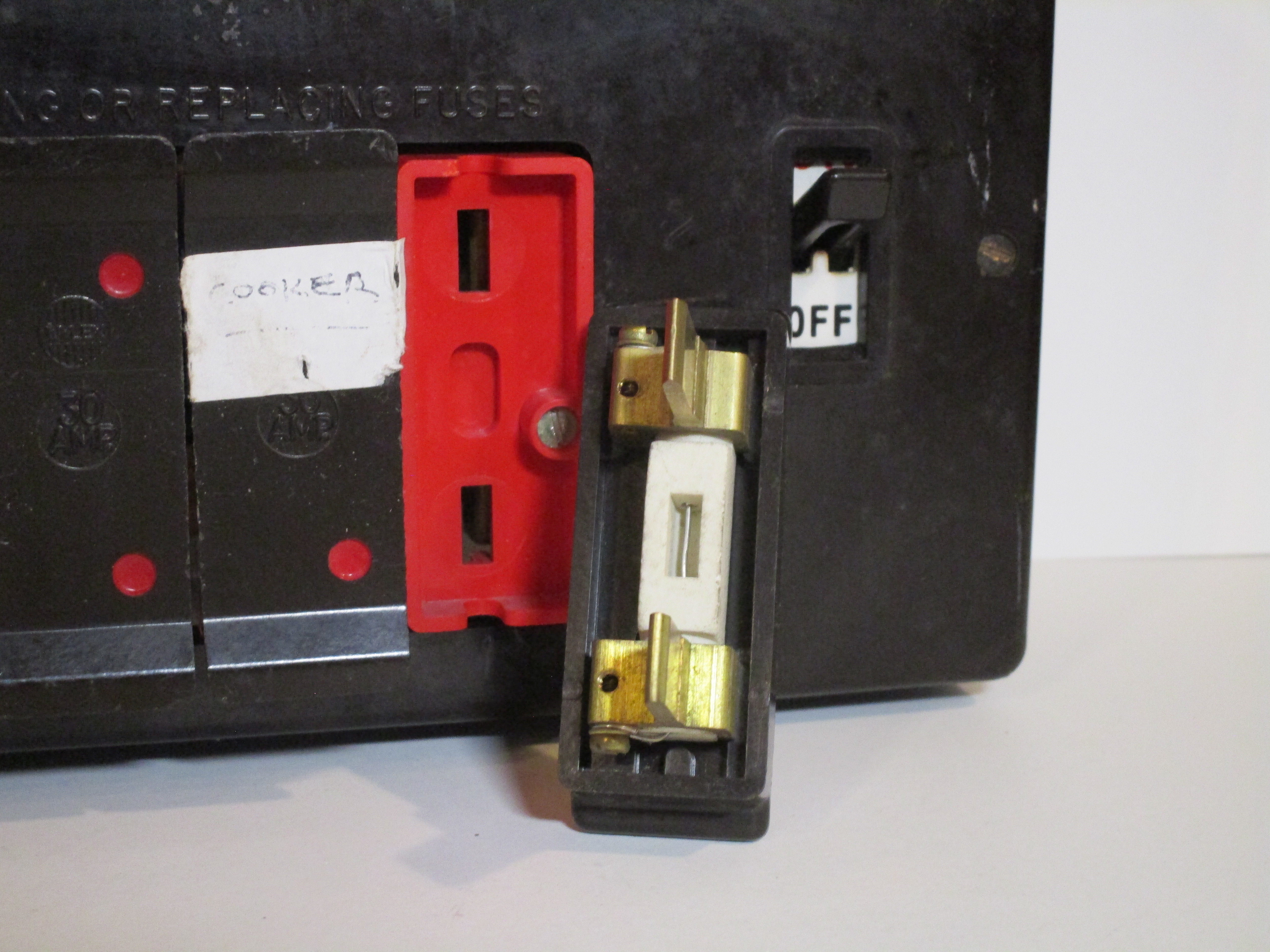

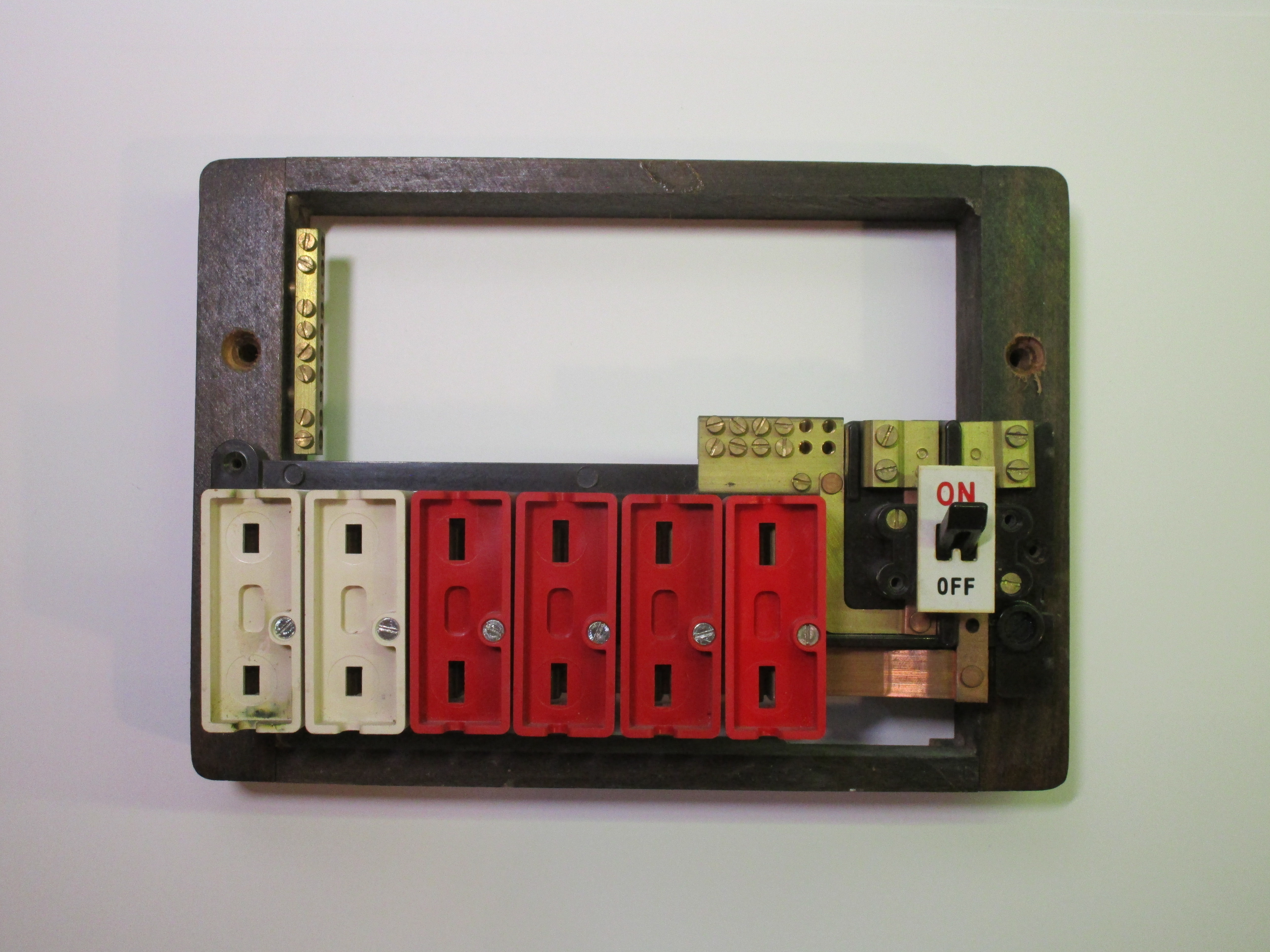
The front cover, made of dark brown plastic, can be removed by undoing two screws and pulling out all the fuses. The internal frame in these older Wylex boxes was made of wood and lacked a rear covering, as that was an optional item.
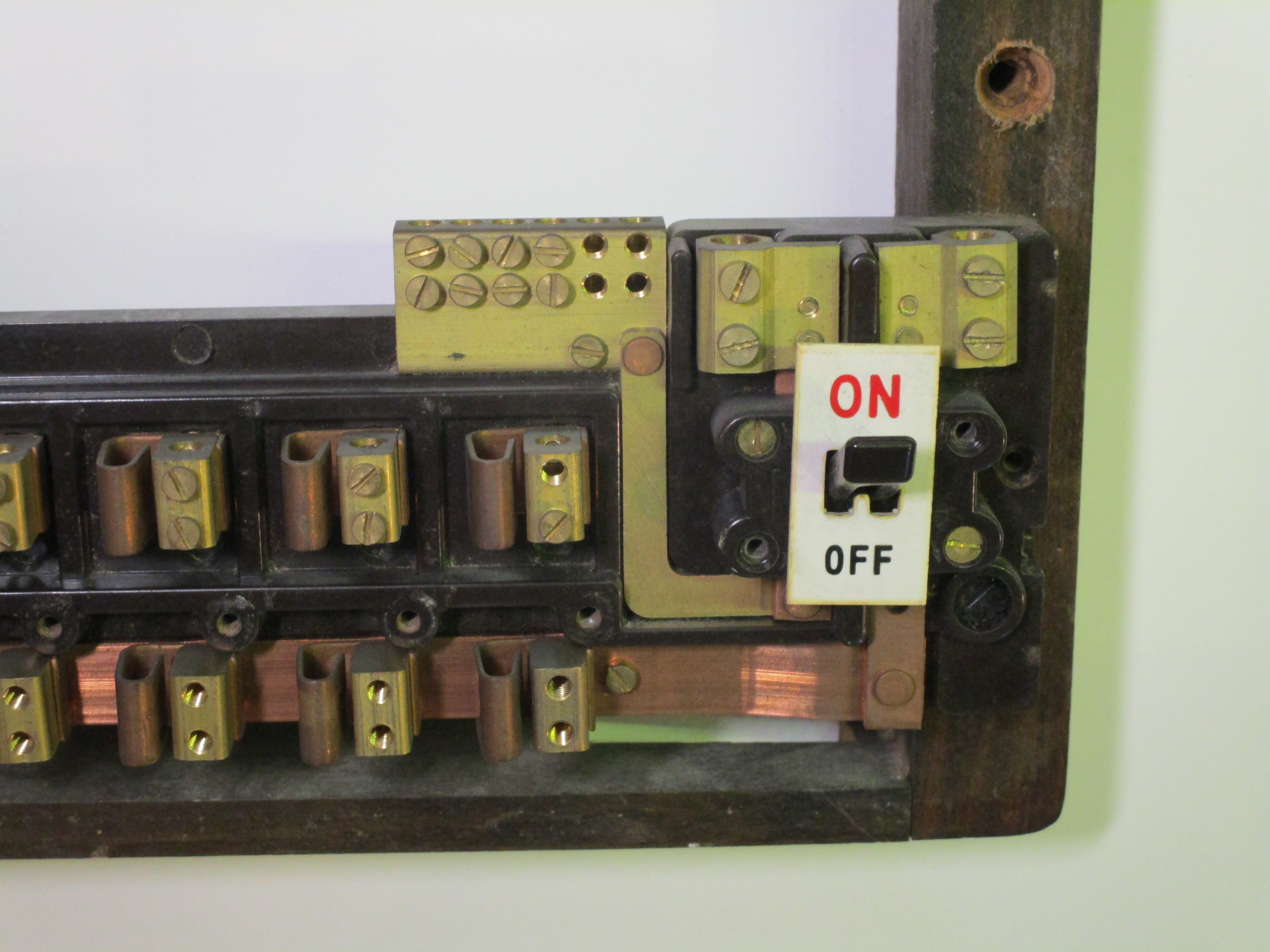
The fuse modules are inserted into coloured shields, plastic covers which impede touching the live busbar underneath and prevent the insertion of one with a higher rating, thanks to differently sized holes. These shields are removeable with a single screw and can be freely added to any position, though it was common practice to place circuits with the highest load closest to the main switch to reduce strain on the busbar. If a space wasn't used, a special blank shield needed to be fitted; otherwise live parts would be exposed.
Screw terminals for each of the circuits are adjacent to the contacts for the fuse inserts. The earth bar is on the top left, and while small it's likely that only some of the circuits would've been connected to it. The neutral bar is next to the main switch.

MEM breaker box
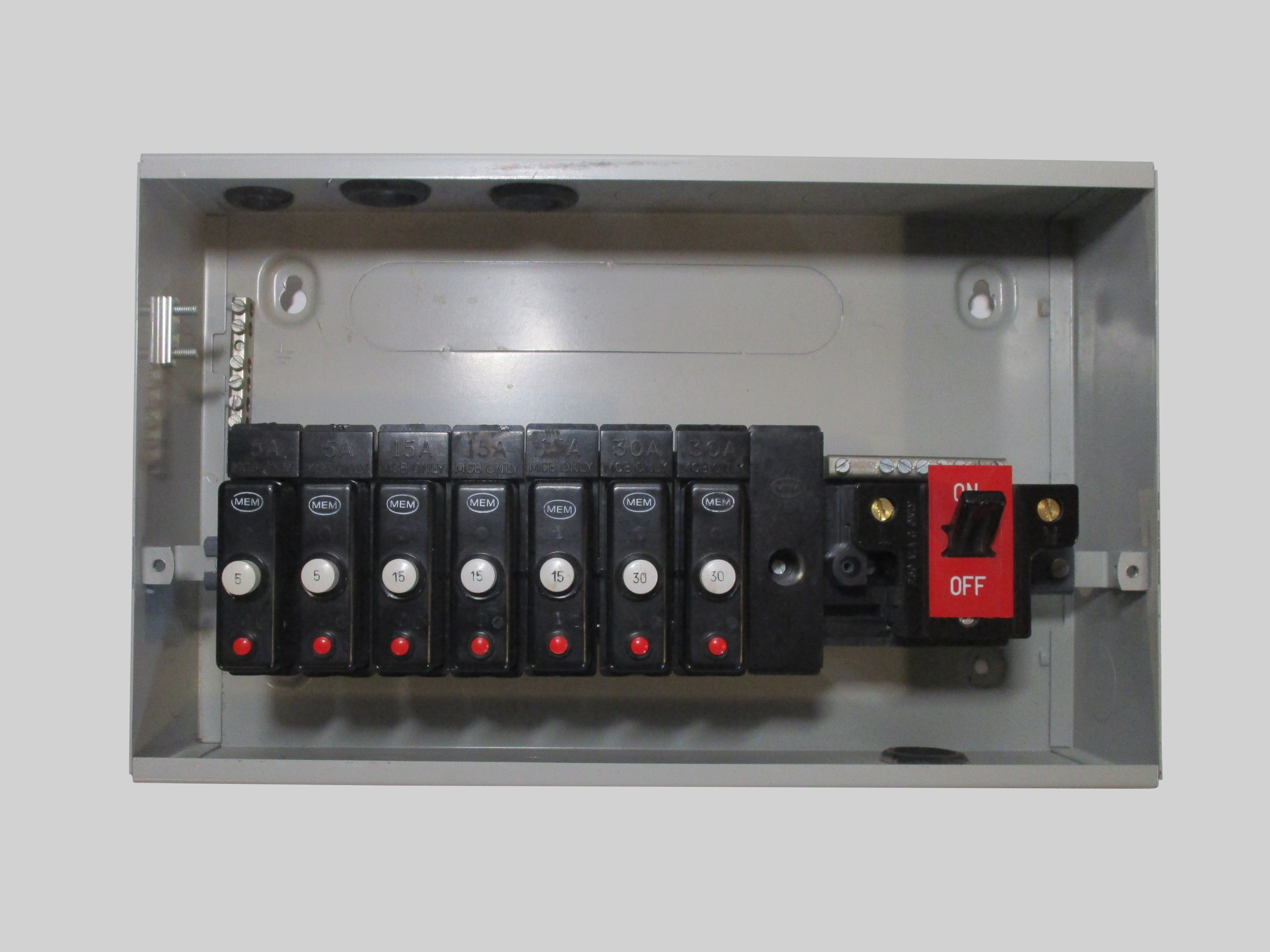
The consumer unit shown here is a Memera 3 by MEM (Midlands Electric Manufacturing). MEM fuse boxes were a common alternative to the ubiquitous ones sold by Wylex, and work in a similar way. This specific version is a roomy 8-space model, made of metal, and was fitted entirely with circuit breakers, which at the time were considerably more expensive than fuses. This would've made it a somewhat early example of a household breaker box, and certainly a high-end item for the era.

At the front there's the main switch, on the right, and the eight circuit spaces, in this case occupied by seven breakers and one blank shield. On top of each circuit a small label is present, to write down its function, although here they all appear to be blank. There are also slots for a clear plastic lid, which is sadly missing.
As was typical of these early MCBs (Miniature Circuit Breakers), they are toggled using push buttons rather than a lever: a large white one, inscribed with the rating of the breaker, for on and a small red one for off.
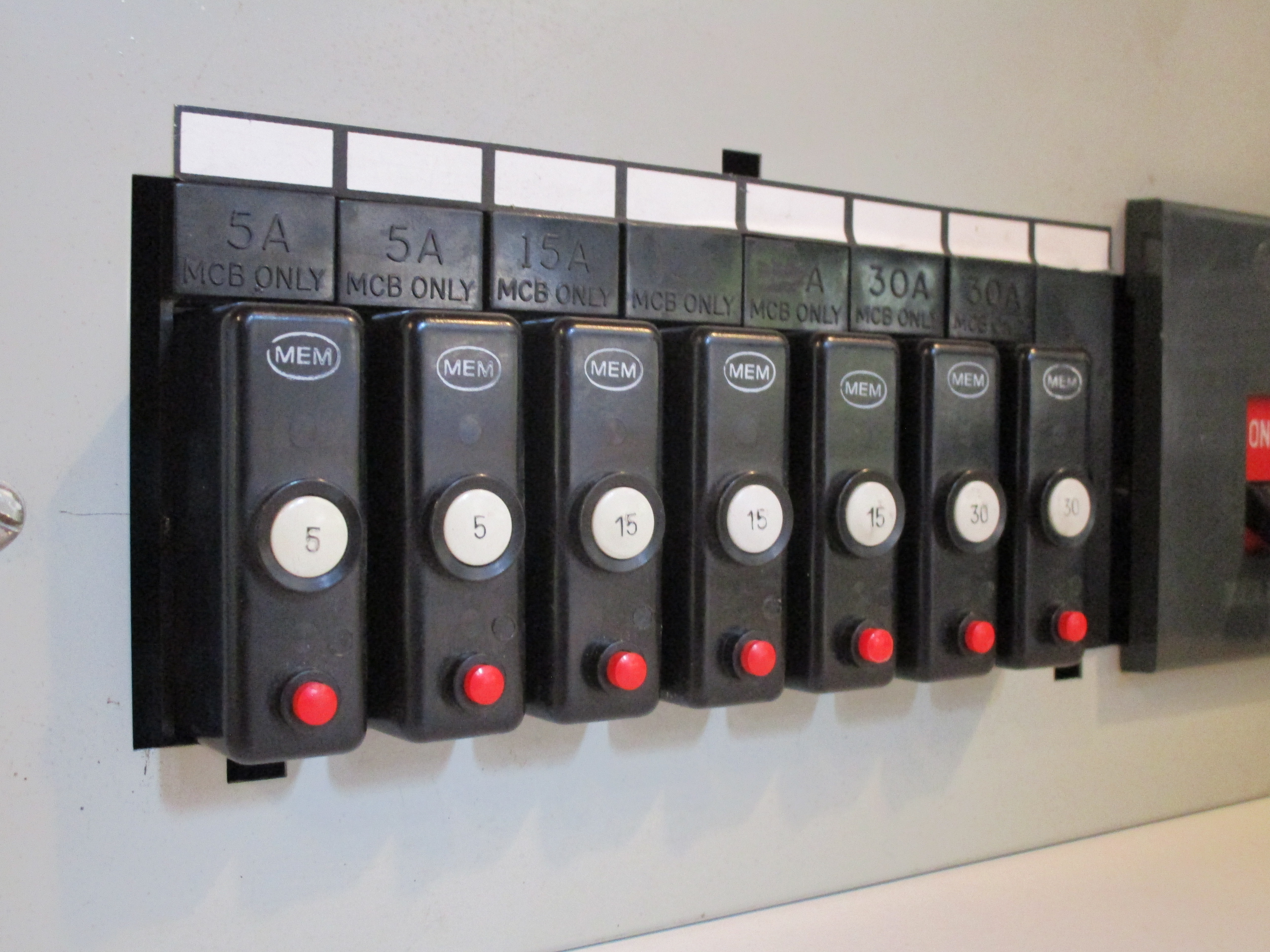

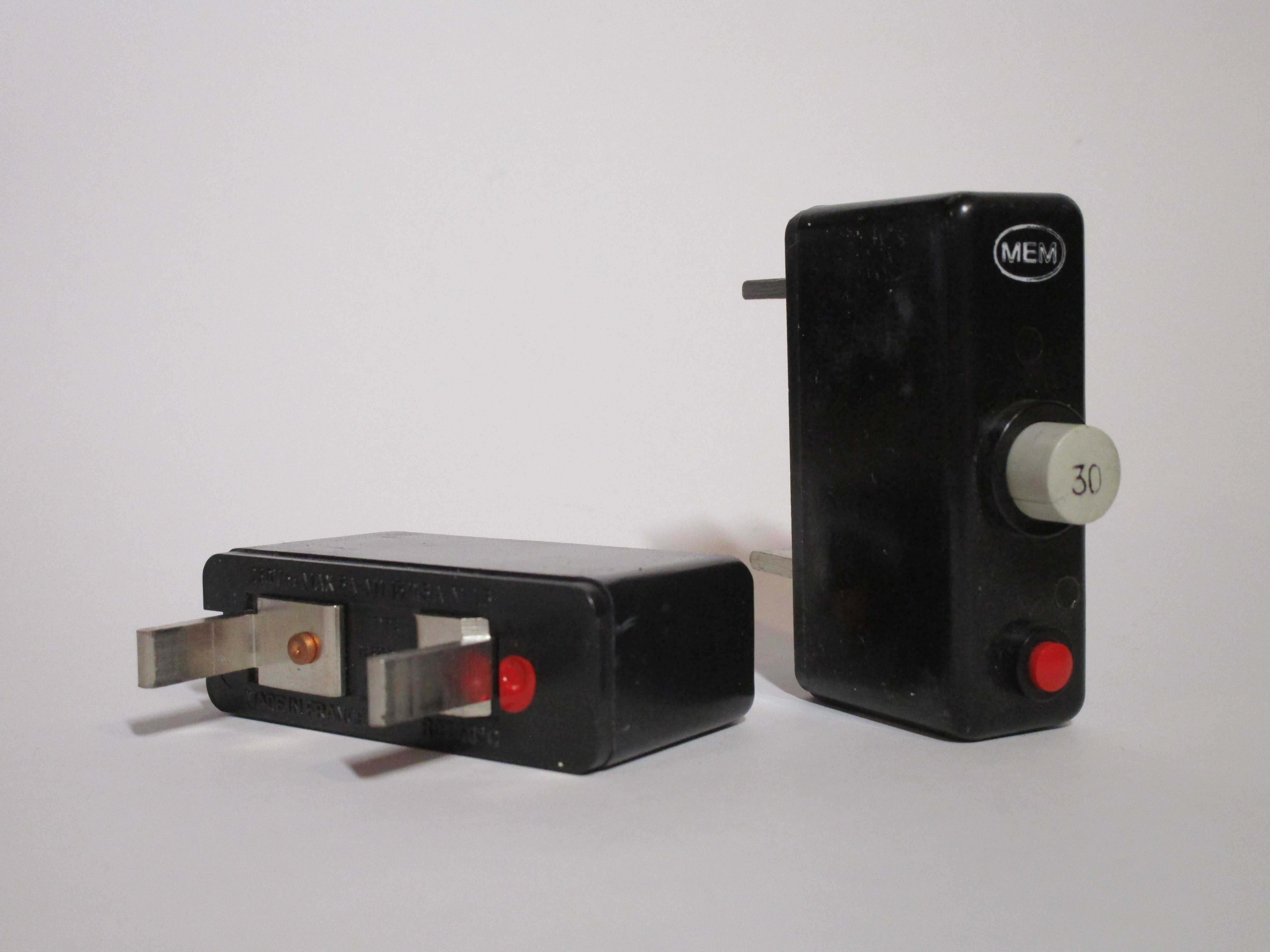
The front cover easily unscrews, revealing the inner components. As this type of consumer unit is still primarily designed with fuses in mind, it follows the same general design seen previously of having removable "modules", which could be either fuses or breakers, that plug into a busbar. Plastic shields remain necessary to cover up the busbar and prevent the insertion of a fuse or breaker of a larger size. The shields are inscribed with the rating of the circuit they're wired to, as well as "MCB ONLY", to indicate that they are only to be used with breakers. Were fuses to be fitted, a separate type of shield would be required. MEM fuse holders and shields followed the conventional white/blue/yellow/red UK colour coding to indicate their amperage, while breakers were never colour coded.
The whole busbar and switch assembly, rated for 80A, is raised to allow for wires to be routed underneath and can be removed by loosening one screw and completely unscrewing another, freeing up space for the wiring process and making it easier to add the various shields and modules as required.
A brief look around the metal chassis reveals several knockouts of various sizes to allow wires to be brought in, including two sizeable ones at the back. In this instance four of these knockouts have been used, and the appropriate rubber grommets have been fitted to prevent damage to the cables. Terminal bars for the neutral and earth connections are present, the former being next to the main switch and the latter on the top left of the chassis; they both have eight screw terminals, one for each circuit. Additionally, a large "clamp" has been placed on the side of the unit to connect the main incoming earth cable.